The right hand Royal Marine shoulders a .303” Lee Enfield Rifle fitted with a launcher for No: 36 Grenades. A primed Grenade fitted with a 7:second Fuse would be placed into the cup-like fitting and fired using a Ballastite Cartridge (like a powerful blank round) so powerful that the normal grip on the small of the butt would not be used and the trigger ‘stroked’ using a stiff fore-finger. The rifle could be used as normal otherwise with some effect on accuracy.
Posted by David Prichard on Mon 31 Aug 2020 20:27:26 BST
The Royal Marine second from right is holding a 2” Mortar Bomb Carrier of holding 6 Bombs.
Posted by David Prichard on Mon 31 Aug 2020 20:18:40 BST
The Nissen Hut seems to indicate this might be on Woodbury Common (also known as Dalditch) where the Corps still trains today.
Posted by David Prichard on Mon 31 Aug 2020 20:14:48 BST
The right hand man is a RM Commando holding QMS (now WO2)
Posted by David Prichard on Mon 31 Aug 2020 20:12:33 BST
This is probably a US made half-track vehicle adapted for use by FOB personnel.
Posted by David Prichard on Mon 31 Aug 2020 20:09:59 BST
The Royal Marine nearest camera is carrying 2 inch Mortar capable of using HE, Smoke and Para Illumination Rounds.
Posted by David Prichard on Mon 31 Aug 2020 19:51:56 BST
Corporal Shellard RM was an Assault Engineer (AE) forming part of a Support Troop. He finished as a QMS (WO2) and then joined the Prison Service where he worked until retiring. Sadly he a Crossed the Bar some time back but I have an occasional pint with two of his nephews. A cracking Man and Royal Marine.
Posted by David Prichard on Mon 31 Aug 2020 19:47:59 BST
I asked Marine Cliff Welsh RM (45RM Cdo) about the Bikes and was told they were ditched almost immediately together with some other items which gave no advantage.
Posted by David Prichard on Mon 31 Aug 2020 19:40:20 BST
His weapon looks like something I saw on HMS ‘Vanguard’ which was called a Lanchester looked like a posh Sten with fixed wooden butt.
Posted by David Prichard on Mon 31 Aug 2020 19:17:13 BST
These Marines are arming No: 36 HE Grenades. These come in the very distinctive wooden box seen. Each has to be armed with a 4 second fuse. Two Grenades can be seen on the deck to his right on the right hand man. Killing Zone 25 yards but the base plate could kill up to 100 yards. Contrary to popular belief the Grenade is pulled FROM the pin where the thrower has a finger of the left hand through the split pin and the man pulls back to the full extent of the right arm before lobbing the actual Grenade at the enemy and taking cover!
Posted by David Prichard on Mon 31 Aug 2020 18:57:08 BST
The Jebel Jihaf .
Posted by David Prichard on Mon 31 Aug 2020 18:43:10 BST
The Camp was wholly tented, protected by dry-stone walls and barbed wire and armed Sentries. The high ground in the background was the Jebel Jihaf (7920 feet) we used to patrol up to, and along the plateau attop.
Posted by David Prichard on Mon 31 Aug 2020 18:41:41 BST
The small neat houses near the Beach housed BP families with their Lido in clear view, this was protected by anti-shark nets. We were allowed access to beach and swimming. I swam out to the raft in the Lido many times! We were under orders to be on best behaviour when there (or else!).
Posted by David Prichard on Mon 31 Aug 2020 18:35:47 BST
The BP Refinery is away to the left. The building in between housed the 11 Hussars (Cherry pickers) and 45 Commando RM .
Posted by David Prichard on Mon 31 Aug 2020 18:31:30 BST
This is a RN Wessex “Whirlwind” operating from a Commando Carrier off shore, given the date it was probable HMS “Bulwark” the ability to ‘lift’ any significant weight being badly affected by the heat and altitude at Dhala.
Posted by David Prichard on Mon 31 Aug 2020 18:27:38 BST
When 45 was stationed at Dhala supplies came up the Dhala Road from Aden the Capital and negotiated the Khiriba Pass so that the high ground overlooking that Pass was always picquetted to ensure safety. These Marines look very relaxed, no weapons to hand so perhaps there was no immediate threat.
Posted by David Prichard on Mon 31 Aug 2020 18:22:54 BST
This Norwegian Commando is holding his Personal Weapon the .303 inch Lee Enfield which was standard issue. What is unusual is that it is fully ‘cocked. Look below the raised rear leaf sight you can see that the cocking device is fully extended, if there is a round in the chamber the weapon is safe provided the safety catch is ‘on’ . Judging his appearance he may be on a Rifle Range and not in contact with the enemy.
Posted by David Prichard on Mon 31 Aug 2020 18:04:43 BST
The piece of kit on the floor is a collapsible assault boat and the oars are clearly shown. The Commando walking centrally seems to be carrying a Field a Radio as it is certainly heavy so he may be a Signaller.
Posted by David Prichard on Sat 29 Aug 2020 19:16:33 BST
There are three Bren Gunners in this photo. The left hand man has a FFD strapped over a wound above the left eye, but seems unconcerned. The right hand Bren Gunner has a 28 round magazine in the left top pocket.
Posted by David Prichard on Sat 29 Aug 2020 19:09:43 BST
The Commando seen emerging from the hatchway is wearing a souvenir German cap with the Eagle and Swastika in clear view so he must have got to very close quarters in Dieppe! The man behind holds a Bren LMG across the shoulder whilst Gunner Ruskin holds his Thompson Sub-machine Gun. He may have been wounded as his right hand denim leg is gone and it appears that a First Field Dressing has been applied (FFD - A pre-packed sterile bandage carried by all British Infantry soldiers and which should only be used to treat him. If Morphine has been administered the letter M in blood would be placed on his forehead.
Posted by David Prichard on Sat 29 Aug 2020 19:01:01 BST
Proudly displaying the Cross of Lorraine Free French flag.
Posted by David Prichard on Sat 29 Aug 2020 18:40:38 BST
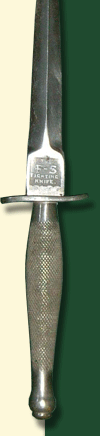
This Commando is holding his Personal Weapon the US made Thompson Sun-Machine Gun which is also depicted on his right shoulder Combined Operations ‘flash’. I think that the hilt of his F & S Commando Fighting knife can just be seen in his right hand map-pocket.
Posted by David Prichard on Sat 29 Aug 2020 18:37:52 BST
This French Commando Officer wears the Cap Badge depicting the Cross of Lorraine symbol of The Free French. He is wearing his Commando Toggle Rope which seems to have been adopted as Badge of Honour by the French as they can be seen wearing them in many Parade photos.
Posted by David Prichard on Sat 29 Aug 2020 18:27:35 BST
In the preparations for the Invasion Troops trained in bombed-out areas of British Cities where they could practise and rehearse ’Fighting in Built-up Areas’ (FIBUA) as opposed to training in areas of open land such as the Hills and Moorland. In some parts of the UK whole areas were taken over and all the inhabitants and livestock moved out. Some have never been allowed back with those areas still retained by the MoD for Military Training. One is near Thetford in Norfolk, another at Imber on Salisbury Plain and the third is near Lulworth Cove which includes a ‘live’ Tank Gunnery Range. The whole of the South Hams in Devon was cleared for ‘live’ Infantry Training (means weapons were being fired ).
Posted by David Prichard on Sat 29 Aug 2020 18:15:00 BST
When a bullet is fired whatever it hits First is called ‘the first catch’ and is not necessarily a human target. What most people call a bullet is actually a ‘round’ made up as follows in Military terms: (A) The actual bullet which is copper coated and lead filled; (B) A brass cylinder ejected after firing; (C) The Cordite explosive which looks similar to broken graphite lead from a propelling pencil; (D) The Fulminate of Mercury cap at the base of the cylinder which is struck by the firing pin when trigger is squeezed (not pulled), this then detonates thru small ports, the cordite explodes and the bullet is fired.
We would demonstrate this to Commando Recruits by opening the round, pouring the cordite onto a safe place and igniting it with a match. The cylinder was then fed into the chamber of the rifle, the trigger squeezed so they would hear the cap ‘go off’
Posted by David Prichard on Sat 29 Aug 2020 15:25:54 BST